



Microsoft removed two sentences from the Azure AI Fundamentals exam description this year, and those two sentences change who should sit the exam. The old AI-900 study guide said the exam was “intended for you if you have both technical and non-technical backgrounds” and that “data science and software engineering experience are not required.” The new AI-901 study guide says instead that you “need knowledge of Python coding syntax and programming techniques” and should be familiar with Azure resources. Same certification name, Microsoft Certified: Azure AI Fundamentals. The price is still $99 in the United States. The exam underneath is very different.
The short version first, then the concepts. AI-900 was retired on June 30, 2026. AI-901 replaced it with a skills outline dated April 15, 2026. The exam now has two domains instead of five: identifying AI concepts and capabilities at 40 to 45 percent, and implementing AI solutions using Microsoft Foundry at 55 to 60 percent. The entire machine learning domain is gone. More than half the exam now asks you to build something, at least on paper, rather than describe it. If you earned AI-900 before the cutover, your certification is still valid, because fundamentals certifications never expire. If you were planning to take AI-900 as a gentle first step into AI, this guide will help you decide whether AI-901 still fits that role.
AI-901 in brief: two domains, 700 to pass on a 1,000 point scale, 45 minutes of exam time, no expiration, and a stated expectation that you can read and write basic Python.
What Happened to AI-900?
Microsoft retired exam AI-900 on June 30, 2026, at 11:59 PM Central Standard Time, and the AI-900 exam page now carries a notice that candidates must pass AI-901 to earn the certification. The certification kept its name and its badge, Microsoft Certified: Azure AI Fundamentals, and the certification page simply notes that the English version was updated on April 15, 2026. A beta of AI-901 ran in April 2026, and the live exam was in place by the June cutover.
AI-901 was one piece of a larger reshuffle. AI-102 retired the same day and became AI-103, Developing AI Apps and Agents on Azure. AZ-204 gave way to AI-200. DP-100 retired on June 1 in favor of AI-300. AZ-500 retired on August 31 and SC-500 replaced it. The pattern across all of them matches AI-901. Microsoft rebuilt its exams around generative AI, agents, and the Foundry platform, and it cut the classic machine learning and named service content the older exams leaned on. The rundown of the most popular Microsoft certifications in 2026 on this site covers the full set of swaps.
What Does the AI-901 Exam Test?
The official AI-901 study guide, last updated July 13, 2026, lists two skill areas. Think of the first as the vocabulary and the second as the workshop.
Notice the verbs. The first domain says identify and describe. The second says create, deploy, build, and test. On AI-900, every domain started with “describe,” and a candidate could pass by knowing which Azure service matched which scenario. On AI-901, the heavier domain expects you to recognize the correct SDK call, the right place in the Foundry portal, and the sensible prompt structure for a given outcome. You will not write code during the exam. Microsoft’s exam experience page confirms that lab time applies only to associate and expert exams, and fundamentals exams do not get access to Microsoft Learn during the test. But the questions are written by people who assume you have opened the Foundry portal and run the SDK at least once.
One naming point will save you confusion. The AI-900 guide said “Azure AI Foundry.” The AI-901 guide says “Microsoft Foundry.” Microsoft’s Foundry overview lists Azure AI Studio and Azure AI Foundry as the earlier names of the same platform. When older study material says AI Foundry and the exam says Microsoft Foundry, they mean the same thing.
What Changed From AI-900 to AI-901?
The cleanest way to see the shift is to put the two outlines side by side. AI-900’s final version, with skills measured as of May 2, 2025, had five domains: AI workloads and considerations, machine learning on Azure, computer vision, natural language processing, and generative AI, each weighted between 15 and 25 percent. AI-901 collapsed those into two.
Microsoft Copilot is not in the AI-901 study guide, which surprises candidates who assumed a 2026 AI fundamentals exam would be a Copilot exam. The exam is about building on Foundry, not using Copilot inside Office. Keep that distinction in mind when you choose study material, because a lot of content labeled “Microsoft AI” covers the wrong product.
AI-901 Exam Format, Cost, and Scoring
A score of 700 or higher on the 1,000 point scale passes, per the AI-901 exam page. Fundamentals exams give you 45 minutes of exam time inside a 65 minute seat, and Microsoft’s general guidance is that its exams contain between 40 and 60 questions, with no published count for AI-901 specifically. The exam is offered in thirteen languages including English, Spanish, French, German, Japanese, Korean, Portuguese, and both Simplified and Traditional Chinese, and you can request 30 extra minutes if it is not available in your preferred language. Delivery is through Pearson VUE, with a separate Certiport channel aimed at schools and academic candidates.
The United States price is $99, which is the long standing fundamentals rate. Microsoft prices the exam by the country where it is proctored, so confirm the figure when you register. Microsoft’s Exam Replay offer bundles a voucher with one retake, both usable within twelve months, and the retake is only available after a failed attempt. Students can apply for academic pricing in most countries by verifying their status in their certification profile. There is a free practice assessment for AI-901 on Microsoft’s AI Skills Navigator, which requires a sign in. And because this is a fundamentals certification, it never expires and never needs renewal, which Microsoft confirms on its certification renewal page. Register with a personal Microsoft account rather than a work or school account, because certification records tied to an employer account are lost if you leave the organization.
Who Should Take AI-901, and Who Should Skip It?
The honest classroom answer is that AI-901 is a fundamentals exam for people who are at the start of a technical path, not a fundamentals exam for everyone. Microsoft’s own audience statement says the candidate is “at the beginning of your career in AI solution development” and names Python. If you are a project manager, a sales engineer, or a business analyst who wanted AI vocabulary and a badge to prove it, the first domain still gives you that. The second domain, though, will ask about SDK clients and agent configuration in ways that assume you have written a loop and called an API. You can still pass with concentrated study, and the free learning paths below are built for it, but go in knowing that the exam moved.
For a developer, a junior data engineer, a support engineer moving toward cloud, or a student in a computing program, AI-901 is a better first step than AI-900 ever was, because the implementation domain teaches a workflow you will use. Compare it with AZ-900, which stayed a purely descriptive fundamentals exam with no coding expectation. The AZ-900 study guide on this site describes an exam about cloud concepts, core services, and pricing models that anyone working in or around IT can sit. AI-901 now sits a half step above that. If you need the vocabulary without the code, take the free “AI concepts” learning path and skip the exam. If you need a credential on the path to AI engineering, take the exam.
How to Study for AI-901
Microsoft publishes two free learning paths for this exam, and the sequence matters. Start with AI concepts for developers and technology professionals, seven modules covering AI concepts, generative AI and agents, natural language processing, speech, computer vision, information extraction, and retrieval-augmented generation. It lists only basic computing and math as prerequisites, and it covers the first domain almost completely. Then move to Get started with AI applications and agents on Azure, another seven modules that walk through the Foundry portal and SDK for generative AI, text, speech, vision, information extraction, and Foundry IQ. That one assumes basic Python, and it is the implementation domain in practice form. Microsoft also runs a one day instructor led course, AI-901T00, Introduction to AI in Azure, and the AI-901 boot camp we run follows the same one day shape with the exam voucher included.
The study method I recommend is to build each of the small applications the outline names, even if you build them badly. Deploy a model in Foundry and talk to it. Write a system prompt, then change it and watch the output shift. Create a single agent in the portal, give it one tool, and test it. Send an image to a multimodal model and ask what is in it. Run a document through Content Understanding. Each of those takes under an hour with the learning path open beside you, and each one turns a bullet on the outline into a memory of a screen you have seen. Candidates who build answer the implementation questions by recognition, while the ones who only read are left eliminating options, and elimination runs out of time on a 45 minute exam.
Study tip: Write the six responsible AI principles on a card and, for each one, note a concrete failure it prevents: a loan model that rates applicants by zip code, a chatbot that invents a refund policy, a vision model that cannot read a form in low light. The exam does not ask you to list the six principles. It describes a failure and asks which principle was violated, and that is a reasoning question, not a recall question.
Where AI-901 Leads
AI-901 is not a prerequisite for anything. Microsoft fundamentals certifications never serve as prerequisites, and the AI-103 study guide does not mention it. But the overlap with AI-103, the Azure AI Apps and Agents Developer Associate exam, is deliberate. AI-103’s domains are planning and managing an Azure AI solution, implementing generative AI and agentic solutions, computer vision, text analysis, and information extraction, which is the AI-901 implementation domain expanded to associate depth. A candidate who passes AI-901 by building the small apps has already met every AI-103 topic at the introductory level. The old path from AI-900 into DP-100 is gone, because DP-100 retired in June, so if data science rather than app development is your direction, look at AI-300 and the MLOps track instead.
Frequently Asked Questions
Is the AI-900 exam retired?
Yes. AI-900 was retired at the end of June 30, 2026. AI-901 is now the only exam for the Microsoft Certified: Azure AI Fundamentals certification.
Does my AI-900 certification still count?
Yes. Microsoft fundamentals certifications do not expire, so an Azure AI Fundamentals certification earned through AI-900 remains valid and carries the same title as one earned through AI-901.
How much does the AI-901 exam cost?
$99 in the United States. Microsoft prices the exam by the country where it is proctored, and verified students qualify for a reduced academic rate in most regions.
What is the passing score for AI-901?
700 on a scale of 1 to 1,000, the same threshold as every other Microsoft technical certification exam.
Do I need to know Python for AI-901?
Microsoft’s audience statement names Python syntax and programming techniques as expected knowledge. No code is written during the exam. The implementation domain does assume you can read SDK examples and understand what a client application does.
How many questions are on AI-901 and how long is it?
Microsoft does not publish a question count for AI-901. Its exams generally contain 40 to 60 questions, and the fundamentals format gives you 45 minutes to answer them, with 65 minutes booked at the testing center.
Is AI-901 harder than AI-900?
It is more technical. AI-900 was written for non-technical and technical audiences alike and was entirely descriptive. AI-901 devotes 55 to 60 percent of the exam to implementing solutions in Microsoft Foundry and names Python as expected knowledge, though it dropped the machine learning theory that many AI-900 candidates found hardest.
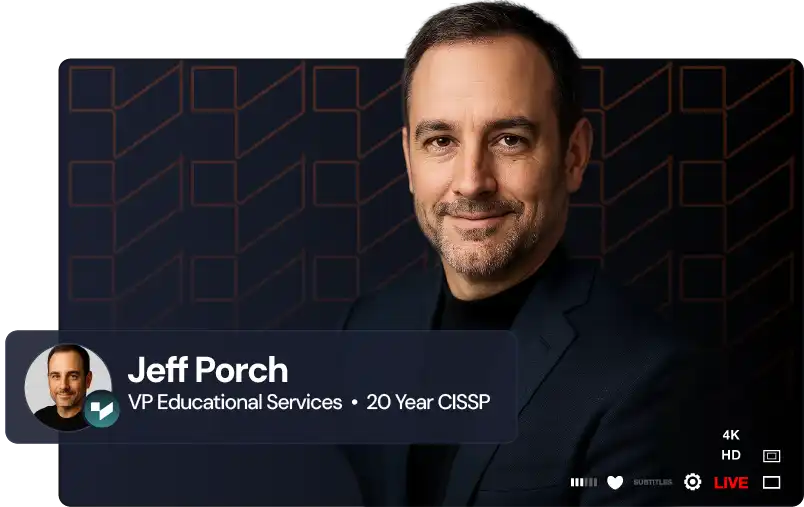
VP of Educational Services | Training Camp
Jeff Porch is the VP of Educational Services and Operations at Training Camp, where he leads the company's educational initiatives with a focus on accelerated learning and student success. Beyond overseeing curriculum development, Jeff serves as the lead course designer for Training Camp's CompTIA Security+ program, one of their most popular offerings. He is deeply involved in the instructional side of the business — developing certification courses, training instructors, and ensuring that complex IT concepts are delivered in ways that maximize retention and minimize time-to-certification.