



AI Is Reshaping Business—But Only If You Have the Right People
REPORT_ID: TC-AI-2025
Executive Briefing
::
Business Strategy
The Key to AI Adoption is Talent
By Christopher D. Porter
|
CEO, Training Camp
By Christopher D. Porter
|
CEO, Training Camp

The data is in, and it’s unambiguous: AI has moved from experimental to essential. Yet, statistics reveal a hidden truth—organizations investing in hardware without investing in human capital are failing to see returns.
Nearly 90% of IT and business leaders now consider AI critical to achieving their goals. McKinsey reports that 88% of organizations use AI in at least one business function, up from 78% just a year ago. Thomson Reuters found that 80% of professionals believe AI will have a “high to transformative” effect on their business within five years.
But here’s what the statistics don’t tell you: AI doesn’t deliver results on its own. The organizations seeing real returns are the ones investing equally in their people.
//
The Three Pillars of AI Value
Gartner frames AI’s business impact in three categories that I find useful: Defend, Extend, and Upend.
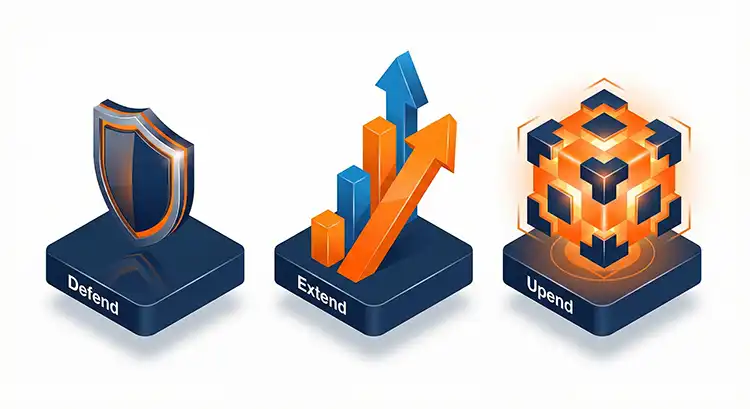
Defend means using AI to improve what you’re already doing—reducing errors, streamlining workflows, catching anomalies. Think fraud detection, quality control, or automating repetitive reconciliation tasks that humans do poorly at scale.
Extend is where AI accelerates growth. It shortens product development cycles, speeds up decision-making, and helps you serve customers faster.
Upend is transformation. This is where organizations use AI to fundamentally rethink their business model, enter new markets, or redefine customer expectations.
//
Where AI Delivers Measurable Returns
Most businesses start with defend, graduate to extend, and only the most mature reach upend. Let me highlight the areas where I see AI creating the most tangible business impact right now:
- Better decisions, faster. AI excels at finding patterns in data that humans miss or don’t have time to find.
- Productivity gains that compound. In software development alone, 37% of engineers report saving four to six hours weekly with AI assistance.
- Predictive capabilities that prevent problems. Manufacturers use sensor data and AI to predict equipment failures before they happen.
- Personalization at scale. AI enables businesses to treat every customer as an individual without the cost of actually doing everything manually.
//
The Challenge Nobody Wants to Talk About
Here’s the uncomfortable truth: most organizations are struggling to capture AI’s full value. The technology is available. The use cases are proven. So why aren’t more businesses seeing transformative results?
The answer is talent.
AI doesn’t implement itself. It doesn’t integrate with your existing systems automatically. That requires people—skilled professionals who understand both the technology and how to apply it strategically.
This is the gap I see most clearly from my position in the training industry. Organizations are investing heavily in AI platforms and tools while underinvesting in the people who need to make those tools work. They’re buying sports cars and handing the keys to people who’ve never driven stick.
//
What This Means for Business Leaders
If you’re leading an organization through AI adoption, I’d offer three observations from my vantage point.
- Your AI strategy is only as strong as your talent strategy. The businesses pulling ahead aren’t just buying AI—they’re systematically building the skills their teams need to deploy it effectively.
- Security has to be central to your AI approach. AI systems create new attack surfaces. The cybersecurity skills shortage was already acute before AI. It’s becoming critical now.
- Don’t wait for perfect conditions. The organizations seeing results from AI started with focused use cases, learned from implementation, and scaled what worked.
The era of AI experimentation is closing. The era of operational necessity has begun. The future belongs to those who have the skills to wield these tools effectively. At Training Camp, we are ready to help you build that future. Let’s get to work.