


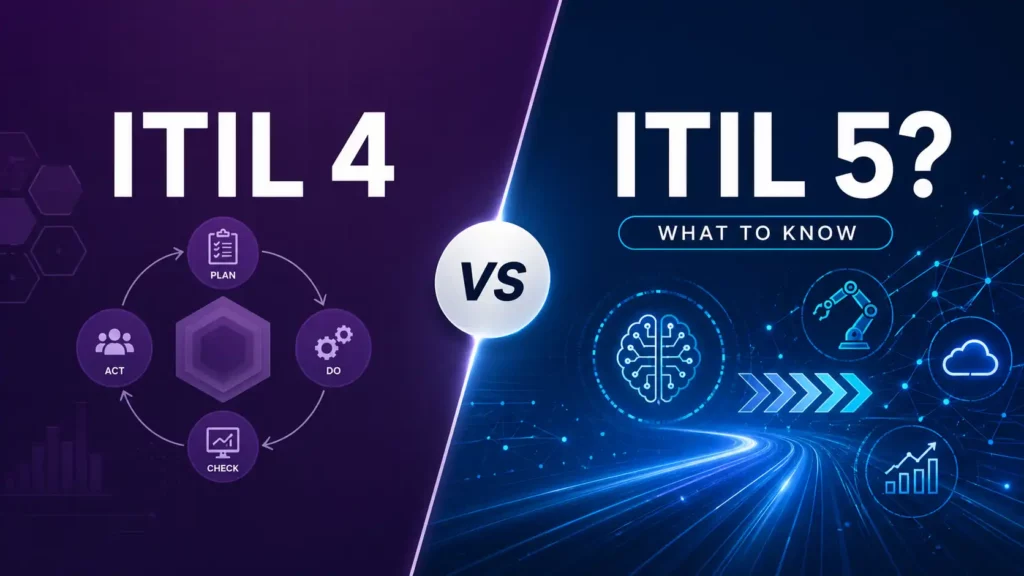
ITIL 5 launched in February 2026, and the questions started hitting my inbox the same week. Do I need to start over? Is my ITIL 4 cert still valid? Should I wait or upgrade now? After 20 years at Training Camp and more than 50 certifications on my own wall, I can tell you the short answer: your ITIL 4 knowledge still counts, but ITIL 5 is a meaningful update that changes how the framework treats digital products, AI, and experience management. This is not a cosmetic refresh.
The two versions will run side by side for at least 12 months, so nobody needs to panic. But you do need to understand what actually changed, what stayed the same, and what it means for your certification path going forward. I have been digging through the official PeopleCert materials and building out our training approach since the announcement, so let me break down the differences that matter.
ITIL 5 retains roughly 40% of ITIL 4 content, introduces 36% completely new material, and modifies another 24%. Your ITIL 4 Foundation certificate is still recognized as a prerequisite for all advanced ITIL 5 modules.
What Is the Difference Between ITIL 4 and ITIL 5?
The biggest structural shift is scope. ITIL 4 defined itself as a framework for IT service management. ITIL 5 officially redefines the framework as guidance for “digital product and service management.” That wording change carries real weight. It reflects what I have been watching happen in real organizations for years: teams are not just managing IT services anymore. They are building, running, and iterating on digital products that combine multiple services, data streams, and user experiences into a single delivery.
ITIL 4 introduced the Service Value System and the Service Value Chain, which was a major step forward from the rigid process orientation of ITIL v3. ITIL 5 takes that further by replacing the Service Value Chain with the Product and Service Lifecycle Model, an eight activity iterative lifecycle. Where ITIL 4 had six value chain activities (Plan, Improve, Engage, Design and Transition, Obtain/Build, Deliver and Support), ITIL 5 expands to eight lifecycle activities that include Discover, Design, Build, Transition, Deliver, Support, Operate, and Evolve. The naming and structure are built to align more naturally with how Agile and DevOps teams actually work.
ITIL 4 kept its practice groups organized into General Management Practices, Service Management Practices, and Technical Management Practices. ITIL 5 removed the Technical Management Practices group entirely and repositioned those practices under a combined Product and Service Management group. All 34 management practices from ITIL 4 are preserved in ITIL 5, but the way they are organized and connected to the lifecycle model has changed.
What Stays the Same from ITIL 4 to ITIL 5?
Before anyone starts worrying about throwing out everything they learned, let me be specific about what carried forward. The seven Guiding Principles from ITIL 4 are fully preserved in ITIL 5: Focus on Value, Start Where You Are, Progress Iteratively with Feedback, Collaborate and Promote Visibility, Think and Work Holistically, Keep It Simple and Practical, and Optimize and Automate. If you studied those for your ITIL 4 exam, that knowledge transfers directly.
The Four Dimensions of Service Management also survive intact: Organizations and People, Information and Technology, Partners and Suppliers, and Value Streams and Processes. These dimensions were one of the strongest additions ITIL 4 made, and PeopleCert clearly recognized that by keeping them as core structural elements in Version 5.
All 34 management practices are preserved as well. Incident Management, Problem Management, Change Enablement, Service Level Management, Continual Improvement, and the rest of the catalog all carry over. The reorganization of practice groups changes how they are categorized but does not eliminate any of the practices themselves. If you have been implementing ITIL 4 practices in your organization, that operational work still applies.
From a training perspective, I tell students to think of it this way: if ITIL 4 was your foundation, roughly 40% of what you studied is directly reusable for ITIL 5. Another 24% has been modified or expanded, so you will recognize the concepts but need to learn the updated framing. The remaining 36% is net new content you have not seen before, mostly around AI governance, product lifecycle thinking, and experience management.
What Is New in ITIL 5 That Was Not in ITIL 4?
Three areas represent net new territory for the ITIL framework. If you are deciding whether to upgrade, these are the capabilities that justify the transition.
AI Governance and Automation
ITIL 4 mentioned automation as a guiding principle (“Optimize and Automate”) but did not provide structured guidance on AI adoption, risk, or governance. ITIL 5 addresses this head on. The framework now includes practical guidance on evaluating AI opportunities, managing AI related risks, establishing accountability structures, and integrating automation into service operations responsibly. There is also a standalone AI Governance extension module, separate from the core certification path, that goes deeper into ethical AI, regulatory considerations, and transparency requirements.
This matters practically because I have watched organizations struggle with exactly this problem. They adopt AI tools for incident triage, automated remediation, or predictive monitoring, but nobody has thought through the governance layer. ITIL 5 at least gives teams a starting vocabulary and decision framework for those conversations. If your organization is deploying or evaluating AI tools, and in 2026 most are, the Version 5 guidance is directly applicable in ways ITIL 4 simply was not. For a broader look at new certifications and frameworks launching in 2026we have covered that separately.
Digital Product Lifecycle Integration
ITIL 4 recognized that organizations were moving beyond traditional IT service delivery, but the framework still organized itself around service management concepts. ITIL 5 formally integrates digital product management into the core model. The new Product and Service Lifecycle Model treats products and services as connected elements of value delivery rather than separate disciplines.
In real terms, this means the framework now covers the full arc from discovery (understanding what customers need) through design, build, transition, delivery, support, operations, and evolution. That last activity, Evolve, is significant. ITIL 4 had Continual Improvement as a practice, but ITIL 5 embeds evolution into the lifecycle model itself. Products and services are expected to change continuously, not just be maintained.
Experience Management as a Core Discipline
ITIL 4 discussed value co creation and stakeholder management, but user experience was not a distinct area of study within the certification scheme. ITIL 5 introduces a dedicated Experience module that covers user, customer, and employee experience design. The goal goes beyond adding customer satisfaction surveys after a ticket closes. The Experience module teaches teams to design services and products around the people who actually use them, from initial interaction through ongoing engagement.
I have seen this gap play out in dozens of organizations where the IT team delivered technically functional services that users hated using. ITIL 5 finally gives service management professionals a structured way to treat experience as a measurable outcome instead of an afterthought.
How Does the ITIL 5 Certification Path Compare to ITIL 4?
The ITIL 4 certification scheme had a reputation for being complex, with overlapping modules and designations that were not always intuitive. ITIL 5 simplifies the structure into nine core modules plus one optional extension, organized around clear professional designations.
The entry point remains Foundation, which launched February 12, 2026. From there, the path branches into three designations. Practice Manager is the operational track, requiring Foundation plus the Transformation module plus one of three combined practice specializations (Monitor, Support and Fulfil. Plan, Implement and Control, or Collaborate, Assure and Improve). Managing Professional requires Foundation plus the Product, Service, and Experience modules plus Transformation. Strategic Leader requires Foundation plus Strategy plus Transformation.
The Transformation module appears in every advanced path. That was a deliberate design choice. PeopleCert’s official ITIL 5 certification page confirms that leading organizational change is a core competency at every level of service management, not just a strategic concern.
ITIL Master sits at the top, requiring all three designations. The AI Governance extension module is separate from the main path and has no prerequisites.
ITIL 5 Foundation Exam: What Changed from the ITIL 4 Exam?
The exam format looks familiar on the surface. Both ITIL 4 and ITIL 5 Foundation exams use 40 multiple choice questions, a 60 minute time limit, closed book, and a 65% passing score (26 out of 40 correct). Those mechanics did not change.
What changed significantly is the content weighting. The ITIL 4 Foundation exam allocated 42.5% of its questions to memorizing seven specific practices in detail. ITIL 5 drops that entirely at the Foundation level. Detailed practice workflows are now covered in advanced certifications where they belong. Instead, the ITIL 5 Foundation exam puts roughly 40% of its weight on the Service Value System and 30% on terminology, including new vocabulary around digital products, agentic AI, experience level agreements, observability, and complexity thinking.
If you passed ITIL 4 Foundation by memorizing practice details, that study strategy will not transfer to ITIL 5. The new exam tests strategic understanding of how the framework fits together, not recall of individual practice workflows. That is a meaningful shift in what “Foundation level” means.
Exam cost note: The standalone ITIL 5 Foundation exam through PeopleCert runs $690 as of April 2026. If you already hold ITIL 4 Foundation, the Foundation Bridge exam costs $263 and covers only the Version 5 updates in a 20 question, 30 minute format. The Bridge path is the most cost effective route for existing ITIL 4 holders who want the Version 5 credential without repeating all the material they already know.
Should I Upgrade from ITIL 4 to ITIL 5?
This depends on where you are in your certification path and what your organization needs. Here is how I am advising people based on the scenarios I am seeing.
If you hold ITIL 4 Foundation only: Your certificate remains valid as a prerequisite for all advanced ITIL 5 modules. You do not need to retake Foundation. The optional Bridge course ($263) gets you the Version 5 Foundation credential if you want it on your resume, but it is not required to progress into advanced ITIL 5 modules. I would recommend the Bridge if your ITIL 4 knowledge is more than two years old, since 36% of the Foundation content is new material you have not studied.
If you are mid path in ITIL 4 advanced certifications: Finish your current ITIL 4 track. The versions are running in parallel, and PeopleCert has confirmed that transition modules from ITIL 4 designations to ITIL 5 designations will be available. Stopping mid path to restart in Version 5 costs more money and takes longer than completing ITIL 4 and then transitioning.
If you are starting from scratch: Go directly to ITIL 5. There is no reason to begin with ITIL 4 in 2026. The content has changed enough that ITIL 4 study materials will not fully prepare you for the Version 5 exam, and Version 5 is the framework that organizations will be adopting going forward. For a broader overview of what ITIL covers and why IT professionals need itstart there if the framework is entirely new to you.
If you hold ITIL v3 Foundation: PeopleCert recommends completing the full ITIL 5 Foundation training and exam. The v3 Foundation is not accepted as a prerequisite for advanced ITIL 5 modules, and the content differences between v3 and Version 5 are substantial enough that bridging would leave too many gaps.
ITIL 5 Certification Renewal: A Change from ITIL 4
One change that catches people off guard is the renewal requirement. ITIL 4 Foundation certificates did not have a mandatory expiration. Once you passed, you held the credential indefinitely unless PeopleCert changed policy. ITIL 5 certificates are all issued with a three year renewal date.
Renewal can be maintained through PeopleCert’s Continuing Professional Development program. The PeopleCert Plus subscription runs $133 per year and allows you to log CPD credits to keep your certification current. Alternatively, passing any ITIL 5 certification exam renews all your existing ITIL certifications within the same product suite, including your ITIL 4 credentials.
Whether you view the renewal model as reasonable maintenance or an ongoing tax depends on your perspective. Objectively, it keeps certified professionals current with framework updates. Practically, it adds a recurring cost that ITIL 4 holders did not have to plan for. Build it into your professional development budget now rather than being surprised in three years.
ITIL 5 Module Release Timeline for 2026
Not everything is available yet. PeopleCert is rolling out ITIL 5 in phases, which means your certification timeline depends on when specific modules launch. Here is the confirmed schedule as of April 2026:
ITIL Foundation launched February 12, 2026. The Foundation Bridge followed on February 26. The Product, Service, and Experience modules became available March 12. Strategy and Transformation launched April 9. The Managing Professional Transition module is scheduled for May 14, 2026. Additional language versions (Spanish, Brazilian Portuguese, Chinese) became available on April 23 for the Foundation exam.
No final retirement date has been announced for ITIL 4 yet. PeopleCert has committed to a minimum 12 month parallel period, and a detailed coexistence and retirement plan will be published before any ITIL 4 certifications are retired. If you are currently mid path in ITIL 4, you have time.
Frequently Asked Questions
Is ITIL 4 Foundation still valid in 2026?
Yes. ITIL 4 Foundation remains valid and is fully recognized as a prerequisite for all advanced ITIL 5 modules. PeopleCert has committed to running ITIL 4 and ITIL 5 in parallel for a minimum of 12 months, and no retirement date for ITIL 4 has been announced as of April 2026.
Do I need to retake Foundation to move to ITIL 5?
No. If you hold ITIL 4 Foundation, you can move directly into advanced ITIL 5 modules without retaking Foundation. An optional Foundation Bridge course ($263, 20 questions, 30 minutes) is available if you want the Version 5 Foundation credential on your record.
What is the main difference between ITIL 4 and ITIL 5?
ITIL 4 is an IT service management framework. ITIL 5 expands the scope to digital product and service management, integrates AI governance guidance, replaces the six activity Service Value Chain with an eight activity Product and Service Lifecycle Model, and adds dedicated modules for Experience and Transformation.
How much does ITIL 5 Foundation cost?
The standalone ITIL 5 Foundation exam through PeopleCert costs $690 as of 2026. The Foundation Bridge exam for existing ITIL 4 holders costs $263. Training packages that bundle instruction with the exam voucher typically range from $900 to $1,600 depending on the provider and delivery format.
How many questions are on the ITIL 5 Foundation exam?
The ITIL 5 Foundation exam has 40 multiple choice questions with a 60 minute time limit and a 65% passing score (26 correct answers). It is a closed book exam with no negative marking for incorrect answers. The format is the same as ITIL 4 Foundation, but the content weighting has shifted toward strategic understanding over practice level memorization.
Does ITIL 5 replace ITIL 4?
ITIL 5 is positioned as an evolution of ITIL 4, not a replacement. PeopleCert has described it as building on proven ITIL 4 foundations while adding new guidance for AI, digital products, and experience management. The 40% content retention from ITIL 4 reflects this continuity. Over time ITIL 5 will become the primary version, but ITIL 4 certifications are not being invalidated.
What certifications does ITIL 5 offer beyond Foundation?
ITIL 5 offers nine core modules leading to four designations: Practice Manager, Managing Professional, Strategic Leader, and Master. Core modules include Foundation, Product, Service, Experience, Strategy, Transformation, and three combined practice specializations (MSF, PIC, CAI). An optional AI Governance extension module is available separately with no prerequisites.

Director, Educational Services | Training Camp
Mark Sabo is the Director of Educational Services at Training Camp, where he oversees the training team, course design, and certification program development. He holds a B.S. in Information Sciences and Technology from Penn State University and more than 50 industry certifications. Mark joined Training Camp in 2005, became a Technical Trainer in 2007, and assumed his current leadership role in 2015. His specialty is practice exam development and exam preparation strategy, built from years of teaching students in the classroom and studying how certification exams are constructed. His writing focuses on the technical details that matter most to professionals preparing for high stakes exams.