



After years of designing CEH curriculum, I have watched the same failure pattern over and over with self study candidates. The official courseware comes out of the box. Practice questions get ground through, sometimes hundreds of them. A makeshift home lab gets cobbled together with Kali Linux and a couple of vulnerable VMs. Two weeks before the exam, the wall arrives. Practice questions feel nothing like the real scenarios from study guides. Reading the AI modules in v13 is like reading a foreign language. Cloud and IoT material has nowhere to attach because none of it has been run for real. About 35 percent of these candidates fail on the first attempt, and a meaningful share of the ones who pass walk out with knowledge so thin it does not survive their first real engagement.
CEH v13 made self study harder, not easier. The AI integration, the expanded cloud and IoT modules, and the heavier scenario weighting on the exam all push against the limits of what a book and a home lab can deliver. This article walks through the specific places self study breaks down on this credential, and why a structured bootcamp model addresses those failure modes in ways most candidates do not realize until they have already burned three months on the wrong approach.
The industry CEH pass rate sits around 65 percent. Candidates who go through structured instructor led training with curated labs pass at meaningfully higher rates. Intelligence is not the variable. What separates the two groups is a set of specific failure modes that self study cannot fix on its own.
Preparing for the CEH exam? Compare class dates and formats for our CEH boot camp.
What Does Self Study Miss With CEH v13?
The structural facts you can read anywhere. CEH v13 launched in September 2024 on Exam Blueprint v5.0. It has 125 questions across 20 modules, a four hour time limit, and a scaled passing score between 60 and 85 percent depending on the form you draw. For the full breakdown of exam mechanics, the CEH v13 exam structure article walks through every domain weighting.
What the structural breakdown does not tell you is what self study actually feels like when it goes sideways. Three patterns show up repeatedly in candidates who fail or barely pass.
The first failure mode is methodology drift. CEH tests an ethical hacking methodology with specific phases, vocabulary, and decision points. Self studiers tend to read about Nmap, then read about Metasploit, then read about Burp Suite, and end up with a pile of tool facts disconnected from any engagement framework. The exam punishes that. Questions assume you understand where in an engagement lifecycle a given technique applies and why you would pick it over an alternative.
Scenario blindness is the second one. CEH questions are not “what does this flag do” questions. They are paragraph length scenarios describing a network condition, a target system, and an analyst’s goal, asking you to pick the right tool or technique. Practicing flag definitions from flashcards does almost nothing to prepare you for that question style. You need to have made these decisions before, in lab settings, under at least some pressure to commit to an answer.
Misallocation of study time rounds out the pattern. The official courseware is large enough that self studiers rarely budget their hours against domain weight. They spend the same amount of time on cryptography (5 percent of the exam) as on reconnaissance (15 percent). Structured programs front load the high weight content and pace the rest. That alone moves the needle on pass rates more than most candidates expect.
A useful gut check before you commit either direction. If you read NIST Special Publication 800-115 on penetration testing and cannot map each of the 20 CEH modules onto a phase of an actual engagement, you are still in the tool fact stage rather than the methodology stage. The exam wants the second one.
The Lab Access Problem
Lab time is where CEH preparation either takes hold or falls apart. Self studiers usually do one of two things, and neither works well. Some never set up a lab at all because the configuration overhead is intimidating, rationalizing that they will pick it up later from videos. Others build a basic Kali plus vulnerable VM setup, work through three or four walkthroughs from YouTube, and convince themselves they have hands on experience. The exam tests for something deeper than either approach delivers.
CEH v13 covers more than 550 attack techniques across 20 modules. A meaningful subset of those techniques need actual lab environments to learn, not just video walkthroughs. Wireless hacking needs a wireless lab. IoT and OT modules need representative devices or solid emulation. Cloud attacks need cloud accounts with intentionally vulnerable configurations. Setting all of that up yourself, configuring it correctly, and producing realistic attack scenarios is a project on its own.
Structured training programs bypass this problem entirely. The lab environment is already built, the vulnerable systems are already deployed, and the scenarios are already mapped to exam content. Candidates spend their time running attacks, not configuring infrastructure. For someone with limited study hours per week, that operational shortcut alone is worth a substantial chunk of the course fee.
Self studiers who want to take this seriously usually need to budget 40 to 60 hours of lab setup and troubleshooting before they ever run their first realistic scenario. That time comes out of the same study window they need for content review, practice exams, and rest. For more on why structured environments produce faster learning, our piece on why bootcamps help students learn faster covers the underlying instructional design reasons.
Why Did the AI Modules Tilt CEH v13 Toward Structured Training?
The AI integration is the single biggest change from v12, and it is also the area where self study breaks down hardest. The exam tests two intertwined skill sets. On the offensive side, candidates need to understand how AI tools enhance reconnaissance, payload generation, social engineering content creation, and evasion. On the defensive side, they need to know how AI driven detection works and how attackers try to evade those AI based controls. Mapping these techniques back to traditional adversary behavior catalogued in the MITRE ATT&CK framework is part of how instructors teach the connections.
This material is too new for the self study ecosystem to have caught up. Most third party study guides were written before v13 launched in September 2024. The free YouTube walkthroughs that exist for the AI modules are uneven, often produced by people who themselves are learning the content. Prompt injection attacks, deepfake awareness, AI assisted malware generation, and AI enhanced reconnaissance all appear on the exam, and the available self study material on these topics is thin compared to traditional CEH content.
Instructors teaching CEH v13 since launch have run these scenarios with hundreds of students and know which specific concepts the exam emphasizes versus which ones get glossed over. That pattern recognition is hard to replicate from a textbook. When a student asks how exactly prompt injection differs from jailbreaking in the exam context, an experienced instructor can answer in 60 seconds with the actual distinction the test makes. A self studier might spend three hours triangulating that answer from incomplete sources.
What Does an Instructor Provide That a Book Cannot?
Most candidates underestimate what an experienced instructor adds to certification preparation. They assume the value is in the lecture content, which they could theoretically read on their own. The actual value sits in three places books and videos cannot reach.
Scenario walkthrough is the obvious one. When an instructor projects a lab environment and works through an enumeration scenario in real time, students see the decision points an experienced operator makes. Why this Nmap flag and not that one. What the output is telling you about the target. When to stop scanning and pivot to active probing. This kind of decision making is exactly what CEH scenario questions test, and it is almost impossible to absorb from a textbook description.
Mistake interpretation is the less obvious one. Self studiers run a command, get an output they do not understand, and either move on or get stuck for hours. In a classroom or live virtual setting, a student can describe what they ran and what they got back, and an instructor can spot the misunderstanding in a few seconds. Compressing that feedback loop from days to minutes is a major part of why structured programs accelerate learning so dramatically.
Exam pattern context is the third. Instructors who have prepared dozens of cohorts for CEH know which question patterns recur, which distractors trap candidates, and which concepts get tested in surprising depth. That contextual knowledge cannot be reverse engineered from a question bank, and it makes a meaningful difference when a candidate is sitting in front of an ambiguous question with two seemingly correct answers.
The Math on Cost Versus Outcome
Cost is the honest part of this conversation. Self study looks cheaper on paper. A standalone exam voucher runs about $950, plus the $100 eligibility application. Add a study guide, a question bank subscription, and some lab time on a third party platform, and you are looking at $1,200 to $1,500 total. Instructor led bootcamps that bundle official training, the voucher, lab access, and exam pass guarantees typically range from $3,500 to $5,000 depending on format.
The cost comparison shifts once you factor in failure rates and time. Industry data suggests roughly 35 percent of self study candidates fail their first attempt. Retake fees, the time cost of additional study, and the opportunity cost of delayed certification add up quickly. A candidate who fails twice and has to extend their job search by six months has lost far more than the upfront cost of structured training would have been.
The time math is the bigger factor for working professionals. Self study takes most candidates 14 to 20 weeks if they are newer to security, or 8 to 12 weeks with a solid background. An intensive bootcamp condenses the structured content delivery into one to two weeks of full time work plus several weeks of practice exam preparation. For someone holding down a job and trying to get certified before a promotion cycle or a contract renewal, that time compression matters more than the dollar difference.
A note on employer reimbursement. Many employers cover structured certification training fully but cap self study reimbursement at the voucher cost. Check your training budget policy before assuming self study is the cheaper option. For some candidates, the bootcamp path is functionally free.
When Does Self Study Still Make Sense?
Self study works for some candidates. Honest curriculum design has to acknowledge that. Three profiles tend to succeed without structured training, and recognizing whether you fit one of them matters before you spend money either direction.
Experienced practitioners who already do the work day to day can usually self study CEH effectively. If you are a working penetration tester, a red teamer, or a security operations engineer with three plus years of hands on experience, the CEH content is mostly a vocabulary alignment exercise. You already make the decisions the exam tests. The work in front of you is learning the credentialing body’s specific terminology and methodology framing.
Strong independent learners with meaningful time budgets are the second profile. If you can reliably commit 10 to 15 hours per week for three to four months, run a real home lab, complete multiple full length practice exams scoring 85 percent or better, and stay accountable without external structure, self study is viable. Most candidates overestimate their ability to do this consistently, but the ones who actually can have a real path.
The third profile is candidates with no employer training support and no personal training budget who have to make self study work because there is no alternative. That is a legitimate position. The approach in that case is to be extremely deliberate about lab setup, methodology mapping, and practice exam discipline, and to expect that the timeline will likely run longer than the bootcamp equivalent.
Outside those three profiles, structured training is almost always the better path for CEH v13 specifically. The AI module additions, the scenario question format, and the lab heavy content all push against the limits of independent preparation more than earlier CEH versions did.
Frequently Asked Questions About CEH v13 Preparation
Can I self study for CEH v13?
Yes, but the success rate is meaningfully lower than with instructor led training. Industry pass rates for CEH hover around 65 percent overall, with a heavier failure concentration among self studiers. Self study works best for practitioners with three plus years of hands on penetration testing experience or candidates with exceptional independent learning discipline.
How much does the CEH v13 exam cost?
The exam voucher alone runs roughly $950 to $1,199. Self study candidates also pay a $100 eligibility application fee. CEH Practical is a separate $550 hands on exam. Bundled training programs that include the voucher and lab access typically run $3,500 to $5,000 depending on format and duration.
How long does CEH v13 preparation take?
Self study takes 8 to 12 weeks for candidates with a solid security background and 14 to 20 weeks for those newer to the field. Intensive bootcamp formats condense the structured content delivery into one to two weeks of full time work plus several weeks of practice exam preparation.
Do I need official training to take CEH v13?
No, but the alternative path requires two years of documented information security work experience plus a $100 eligibility application. Official training through an accredited provider waives both the experience requirement and the application fee, which matters for candidates moving into security from adjacent IT roles.
What is the passing score for the CEH v13 exam?
CEH v13 uses a scaled scoring model. The passing threshold varies between 60 and 85 percent depending on the specific exam form. You will not know your form’s cut score in advance, which is why aiming for consistent 85 percent or better on full length practice exams is the practical readiness benchmark.
Is CEH v13 harder than v12?
CEH v13 is broadly considered more demanding than v12. The exam format remains similar at 125 questions over four hours, but v13 expanded coverage of AI assisted attacks, multi cloud security, IoT and OT, and supply chain exploitation. AI module additions especially benefit from instructor led preparation since most self study material has not fully caught up to the new content.
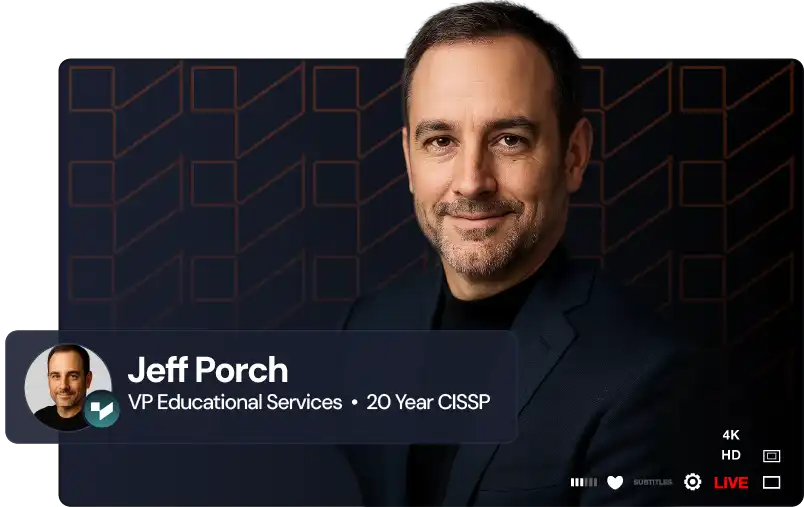
VP of Educational Services | Training Camp
Jeff Porch is the VP of Educational Services and Operations at Training Camp, where he leads the company's educational initiatives with a focus on accelerated learning and student success. Beyond overseeing curriculum development, Jeff serves as the lead course designer for Training Camp's CompTIA Security+ program, one of their most popular offerings. He is deeply involved in the instructional side of the business — developing certification courses, training instructors, and ensuring that complex IT concepts are delivered in ways that maximize retention and minimize time-to-certification.