



A certification exam objectives document is the official specification a certification body publishes for an exam. It names every topic that can be tested, groups those topics into domains, assigns each domain a percentage of the total exam, and signals through its verbs how deeply each topic will be assessed. CompTIA calls it exam objectives. ISC2 calls it an exam outline. ISACA calls it an exam content outline, Cisco calls it exam topics, and Microsoft publishes it as a study guide on Microsoft Learn. Whatever the label, it is free, it is usually a PDF, and it is the only study resource written by the same people who write the questions.
Most candidates download it, scroll through once to confirm the topics look familiar, and never open it again. A student came to me a while back convinced she had a memory problem. She could recite the difference between symmetric and asymmetric encryption on demand, and name every port number I threw at her. And she was still missing a third of her practice questions, without being able to say why. We opened the objectives document together and read one line out loud: “Given a scenario, apply common security techniques to computing resources.” The operative word there is apply, and the setup is a scenario. Everything she had done to prepare was built around recall.
Treat the objectives document as a table of contents and you will study the wrong things at the wrong depth. It was written as a specification, and it rewards being read like one.
What Is a Certification Exam Objectives Document?
It is the output of a job task analysis. Certification bodies survey working professionals, ask what the role actually requires, validate the answers with subject matter experts, and translate the result into a set of measurable statements. Those statements become the published document. ISACA runs this process every three to five years and calls it a Job Practice Analysis. ISC2 calls it a Job Task Analysis and runs it on roughly a three year cycle. The mechanism is the same across vendors even where the vocabulary is not.
Here is the part that matters for your study time. Item writers are bound to that document. A question cannot appear on the exam unless it maps to a published objective, and psychometricians check that mapping during exam development. If something is not in the objectives, it cannot be tested. Skip something that is in there and you are gambling.
Courseware does not carry the same guarantee. A good study guide covers the objectives well, but it also makes editorial choices about depth, sequence, and emphasis. Two authors can read the same objective and write chapters of very different length about it. When your book spends thirty pages on cryptography and four pages on change management, that reflects the author’s interests as much as the exam’s weighting. The objectives document is the only place you find out which one the test actually cares about.
What Do the Verbs in an Exam Objective Mean?
The verb tells you the cognitive level the question will target, which tells you what kind of studying will get you there. Summarize and explain sit at recall and understanding. Compare and contrast sits at boundary knowledge. Given a scenario sits at application. Analyze asks you to interpret evidence, and implement or configure asks for procedure under pressure. A candidate who reads the topic and ignores the verb ends up preparing for the wrong difficulty.
Think about what it would take to satisfy each of these on a live question rather than in your own head.
Go through your objectives document with a highlighter and mark every occurrence of “given a scenario.” On CompTIA Security+ SY0-701, that phrase opens 7 of the 28 objectives, and four of those seven sit inside Security Operations, the heaviest domain on the exam. Those are the ones that will decide whether you pass. If your study method for them is rereading a chapter, change the method, because rereading trains recognition and the exam is asking for judgment. Our breakdown of performance based questions goes deeper on what those items look like in practice.
How Do You Use Domain Weights to Plan Study Time?
Multiply each domain percentage by the total hours you can realistically commit, and treat the result as a budget for that domain. Most candidates glance at the percentages and file them under “interesting.” Those numbers are the single most actionable thing in the document, because they convert directly into hours.
Take CompTIA Security+ SY0-701 as a worked example, using objectives version 5.0, which is the live version as of September 2026. Five domains: General Security Concepts at 12 percent, Threats, Vulnerabilities, and Mitigations at 22 percent, Security Architecture at 18 percent, Security Operations at 28 percent, and Security Program Management and Oversight at 20 percent. Now do the arithmetic. If you have budgeted 80 hours of study, Security Operations deserves about 22 of them and General Security Concepts deserves about 10. Ask any group of candidates where they actually spend their time and you will hear cryptography, ports, and attack types, which live largely in the two smallest domains. Meanwhile the governance and program management content, a fifth of the exam, gets skimmed the night before because it is boring. That is 20 percent of your score treated as an afterthought.
The same arithmetic works anywhere the weights are published. On the ISC2 CISSP exam outline effective April 15, 2024, Security and Risk Management carries 16 percent while Software Development Security and Asset Security each carry 10 percent. The current ISACA CISM exam content outline puts Information Security Program at 33 percent of a 150 question exam, roughly 50 items, against 17 percent for Information Security Governance. Candidates who split their hours evenly across four CISM domains are giving away about a third of the exam.
The weights also tell you something about the role the certification is describing. When a vendor moves ten points from one domain to another between versions, they are reporting a change in what the job looks like. Security Operations became the heaviest Security+ domain because employers said day to day operational work was the gap they were hiring for. Reading the weights as a picture of the job, rather than as a study scoreboard, makes the material easier to hold onto.
Study tip. Build your study schedule as a spreadsheet with one row per objective, not one row per chapter. Chapters are the author’s organization. Objectives are the exam’s organization, and they are what the score report will reference if you fail. When you finish an objective, mark it with a confidence level rather than a checkmark, something as simple as green, yellow, and red. The reds are your plan for the final week.
What Else Is in an Exam Objectives Document?
Past the domain listings you will usually find an acronym list, a suggested hardware and software list, and a paragraph of fine print. The back matter gets treated as filler. It is not.
The acronym list at the end of a CompTIA objectives PDF runs several pages, and every entry on it is fair game as an unexplained abbreviation inside a question stem. Nobody is going to ask you to define SAML. You will get a federation scenario that says SAML and assumes you already know what that implies. When a candidate tells me they ran out of time on the exam, half the time the real problem was decoding vocabulary instead of answering questions. Working that list is some of the highest return studying available, and it takes a couple of hours total. We put together a terminology primer for exactly this problem.
Candidates read the hardware and software list as a shopping list for a lab they cannot afford and move on. Read it as a hint sheet instead. If the document names a protocol analyzer, expect to interpret capture output. A SIEM sitting in that list means log correlation is coming. The tools listed are the tools the item writers had in mind, and they tell you what the practical questions will look like before you ever sit down.
One more piece of fine print worth taking seriously. CompTIA states plainly that the bulleted examples under each objective are not exhaustive and that other technologies or tasks relevant to the objective may appear on the exam. People read that as legal boilerplate. It is a warning. Memorizing the bullets gets you a partial map, and the exam is allowed to test the territory.
How Do You Turn Exam Objectives Into a Study Plan?
Download the current objectives from the vendor and confirm the version code matches the exam you are registered for. Copy every objective into a spreadsheet, one per row, with columns for domain, verb, confidence, and last reviewed. Convert the domain percentages into hours against whatever total you can realistically commit. That setup takes about an hour, before any real studying begins.
Then sort by verb and look at what you are facing. Flashcards are fine for the recall objectives. Comparison objectives want two column notes with the distinguishing detail written out. Anything that says given a scenario or analyze needs worked problems or hands on time, and the implement objectives need a lab or a simulator you can actually run. That sort is most of the trick, because it stops you from applying one study method to five different kinds of question.
Then make three passes over the material. The first is wide and shallow, reading or watching across every objective without stopping to master anything, so you carry the shape of the whole exam in your head. Go back through in weight order for the second, heaviest domain first, and update the confidence column honestly as you go. The last pass is pressure work. Timed questions and hands on time, with every miss traced back to a specific objective number rather than a vague feeling that you are weak on networking. That traceability is what makes the final two weeks productive instead of anxious.
Hands on time does not require a budget. NIST Special Publication 800-115, the Technical Guide to Information Security Testing and Assessmentwalks through the assessment techniques that scenario questions are built around, and the Cybersecurity and Infrastructure Security Agency maintains a public catalog of free cybersecurity services and tools you can practice with on your own machine. Pair either one with the objectives that use analyze or implement and you have a practice plan that costs nothing. If packet capture is on your list, our Wireshark walkthrough is a reasonable starting point, and reading security logs covers the artifact interpretation that analyze objectives keep asking for.
Which Exam Outlines Are Changing in 2026?
Four widely held credentials are mid transition right now, which makes the version check more than housekeeping. If your test date falls on the wrong side of one of these dates, the document you studied from is not the document your exam was built from.
Check the version number on your PDF against the exam code on your registration before you build anything. Security+ candidates studying right now should know that a new version of the exam is close enough to change the calculation on when to sit. Retired objectives documents stay in circulation for years, because they have accumulated links and search rankings that the current one has not caught up to yet.
Why Studying Straight From the Objectives Sometimes Fails
The common problem is treating an objective as the ceiling rather than the floor. An objective is a statement of what gets measured, written at a level general enough to survive several years of technology change. “Explain the purpose of mitigation techniques used to secure the enterprise” is a sentence. The actual knowledge behind it is a chapter. Candidates who check an objective off after reading the bullets underneath it are confusing the label with the content.
There is a subtler version of this, and it is the one I watch for most in class. A candidate maps everything carefully, works every objective, marks them all green, and still walks out of the testing center unsure. Usually what happened is that they studied each objective in isolation, and the exam asked a question that sat across three of them at once. Real scenarios do not respect domain boundaries. An incident response question can pull identity, logging, and governance into the same item stem. Somewhere in your second pass you need to start connecting objectives to each other rather than just clearing them, and the easiest way to do that is to take any scenario you have worked and ask which other objectives touch it.
Frequently Asked Questions
What is a certification exam objectives document?
It is the official specification a certification body publishes describing exactly what an exam measures, broken into domains with percentage weights and individual objective statements. CompTIA calls it exam objectives, ISC2 calls it an exam outline, ISACA calls it an exam content outline, Cisco calls it exam topics, and Microsoft publishes it as a study guide. Item writers can only write questions that map to a published objective, which is what makes the document authoritative.
Where do I download the official exam objectives?
Always from the certification body itself rather than a third party mirror. CompTIA, ISC2, ISACA, Cisco, PMI, and Microsoft all publish current objectives on their own certification pages, free and sometimes behind a short email form. Third party copies go stale quietly and are the most common reason candidates end up studying a retired version.
What does “given a scenario” mean in an exam objective?
It means the question will present a situation with context and constraints and ask you to choose the best course of action, rather than asking you to define or identify something. These objectives sit at the application level and are where most performance based questions come from. On CompTIA Security+ SY0-701, the phrase opens 7 of the 28 objectives, four of them in the Security Operations domain.
How do I use domain percentages to plan study time?
Multiply each domain percentage by the total hours you can realistically commit and treat the result as a budget for that domain. With 80 hours available and a domain carrying 28 percent of the exam, that domain gets roughly 22 hours regardless of how interesting you find it. Splitting time evenly across domains is the most common planning error and it is the easiest one to fix.
Which certification exam outlines are changing in 2026?
The ISC2 CCSP moved to a new exam outline on August 1, 2026, and the ISC2 CC moved on September 1, 2026. ISACA has announced an updated CISM exam content outline effective November 3, 2026, and CompTIA has published draft objectives for Security+ SY0-801 with a tentative late 2026 launch. Confirm which outline applies to your scheduled test date before you buy study material.
Is studying the exam objectives enough to pass?
No, because the objectives tell you what is measured, not the underlying knowledge itself. CompTIA states that the bulleted examples under each objective are not exhaustive, so the document works as a map and a checklist while your study materials and hands on practice supply the actual content.
How do I know if my exam objectives document is the current version?
Compare the exam code and objectives version number printed on the document against the exam code listed on your registration or on the vendor’s current certification page. CompTIA Security+ is on objectives version 5.0 for SY0-701, and the CISSP outline in force took effect April 15, 2024. A mismatch between the two is a signal to stop studying and redownload before you go any further.
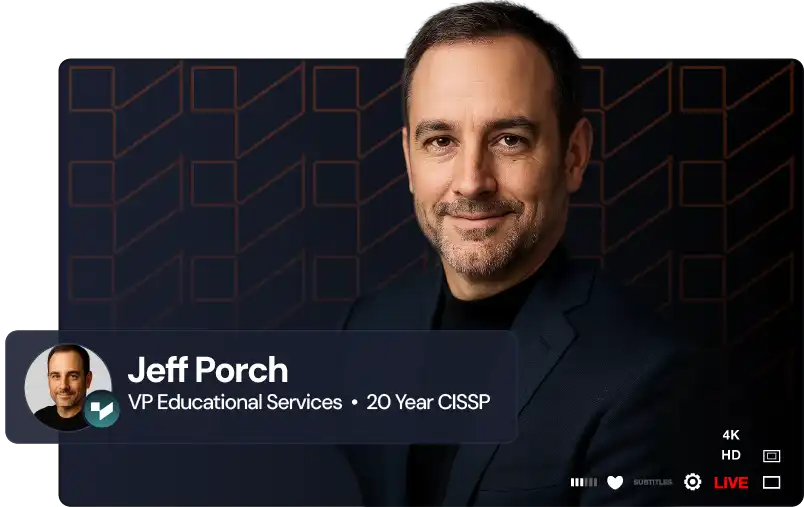
VP of Educational Services | Training Camp
Jeff Porch is the VP of Educational Services and Operations at Training Camp, where he leads the company's educational initiatives with a focus on accelerated learning and student success. Beyond overseeing curriculum development, Jeff serves as the lead course designer for Training Camp's CompTIA Security+ program, one of their most popular offerings. He is deeply involved in the instructional side of the business — developing certification courses, training instructors, and ensuring that complex IT concepts are delivered in ways that maximize retention and minimize time-to-certification.