


Hello, you are using an old browser that's unsafe and no longer supported. Please consider updating your browser to a newer version, or downloading a modern browser.
Training Camp • Cybersecurity Glossary
A cellular network divides coverage into cells served by base stations, letting mobile devices roam; security spans SIM authentication, encryption, and 5G protections.
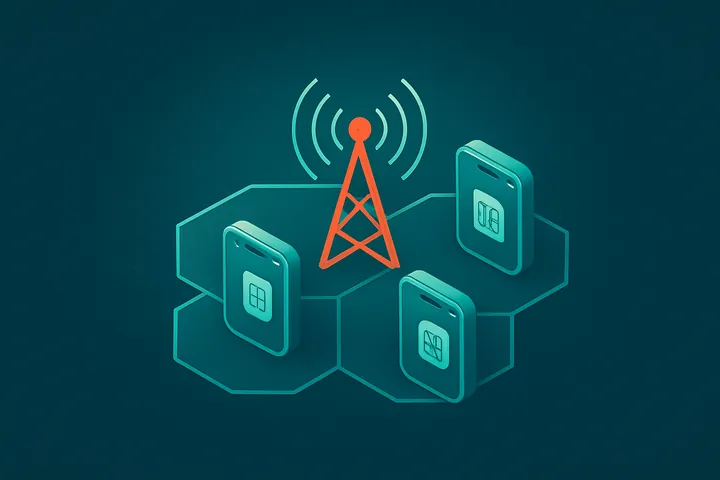
Cellular Network Definition: A cellular network divides coverage into cells served by base stations, letting mobile devices roam; security spans SIM authentication, encryption, and 5G protections.
A cellular network is a radio communication system that divides a geographic area into cells, each served by at least one fixed transceiver called a base station or cell site. Mobile devices connect to the nearest base station and hand off to adjacent cells as they move, maintaining continuous voice and data connectivity across wide areas while reusing radio frequencies between non-adjacent cells.
The network is organized into a radio access network of base stations (such as eNodeB in 4G LTE and gNodeB in 5G) and a core network that manages authentication, mobility, and routing to other networks and the internet. A subscriber identity module (SIM or eSIM) holds cryptographic keys used to authenticate the device to the carrier and to derive session encryption keys. Successive generations, 2G/GSM, 3G/UMTS, 4G/LTE, and 5G, brought stronger ciphers, mutual authentication, and improved integrity protection.
For security, cellular networks face threats including IMSI catchers (such as Stingrays) that impersonate base stations to track or intercept devices, downgrade attacks that force connections onto weaker 2G encryption, SIM swapping that hijacks phone numbers to defeat SMS-based authentication, and signaling-protocol abuse via SS7 and Diameter. 5G introduces concealed subscriber identifiers (SUCI) and stronger mutual authentication to counter several of these. Enterprises layer additional controls because business data and second-factor codes travel over these networks, following guidance such as NIST SP 800-124 for mobile device management.
For example, a corporation issues phones with mobile device management that enforces device encryption, requires a VPN for corporate access, and disables 2G fallback to block downgrade attacks. When an employee drives across the city, their phone hands off through dozens of cells without dropping the VPN session. Meanwhile the security team moves multi-factor authentication off SMS to an authenticator app, recognizing that SIM swapping and SS7 interception can compromise text-message codes delivered over the cellular network.
Turn knowledge into credentials with our instructor-led cybersecurity boot camps.
View All Courses →