


Hello, you are using an old browser that's unsafe and no longer supported. Please consider updating your browser to a newer version, or downloading a modern browser.
Training Camp • Cybersecurity Glossary
It is a spread-spectrum channel access method letting many users share one frequency band at once, each tagged with a unique code — used in 3G cellular.
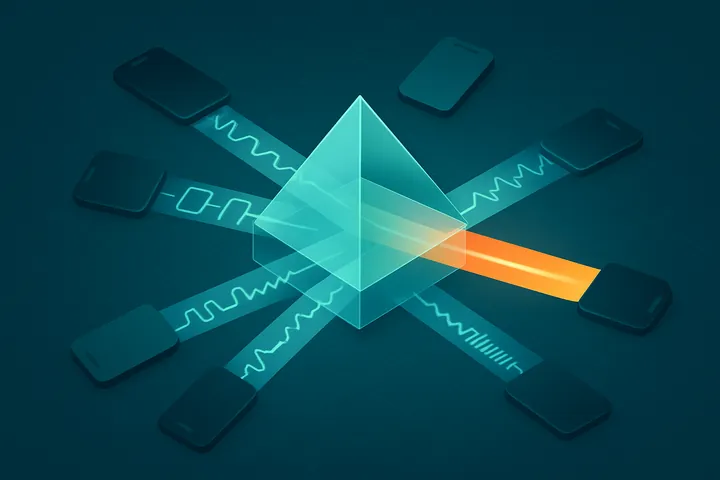
Code Division Multiple Access (CDMA) Definition: It is a spread-spectrum channel access method letting many users share one frequency band at once, each tagged with a unique code — used in 3G cellular.
Code Division Multiple Access (CDMA) is a channel access method that lets multiple transmitters share a single frequency band simultaneously by encoding each signal with a unique spreading code. Receivers use the matching code to extract their data while other transmissions appear as low-level noise, enabling many concurrent users over one channel.
It works through spread-spectrum techniques: a narrowband signal is multiplied by a fast pseudo-random code (a chipping sequence) that spreads it across a wide bandwidth. Because the codes are orthogonal or nearly so, a receiver that knows the correct code can de-spread and recover the intended signal while rejecting others. This underpinned 2G IS-95 (cdmaOne) and 3G CDMA2000/WCDMA cellular networks, contrasting with TDMA (time slots) and FDMA (separate frequencies).
It matters for security because spread spectrum inherently resists narrowband jamming and casual eavesdropping — without the correct spreading code, an intercepted transmission looks like noise and is hard to separate from other users. CDMA also complicates direction-finding and interception, which is why spread-spectrum methods originated in military anti-jam communications. However, CDMA's spreading is not encryption; confidentiality still depends on layered authentication and ciphering, since the codes themselves can be discovered and provide obfuscation rather than cryptographic protection.
For example, a government agency operating in a contested radio environment might deploy CDMA-based secure handsets so transmissions survive deliberate jamming and resist trivial interception, then layer strong end-to-end encryption and SIM-based authentication on top so that even an adversary who recovers the spread signal cannot read the call. In commercial use, a 3G carrier relied on CDMA to let thousands of subscribers share spectrum in one cell, with per-call codes and ciphering keys protecting traffic across the air interface.
Turn knowledge into credentials with our instructor-led cybersecurity boot camps.
View All Courses →