


Hello, you are using an old browser that's unsafe and no longer supported. Please consider updating your browser to a newer version, or downloading a modern browser.
Training Camp • Cybersecurity Glossary
A logical link bundling multiple physical Ethernet ports into one, increasing bandwidth and redundancy. Standardized as 802.3ad/LACP link aggregation.
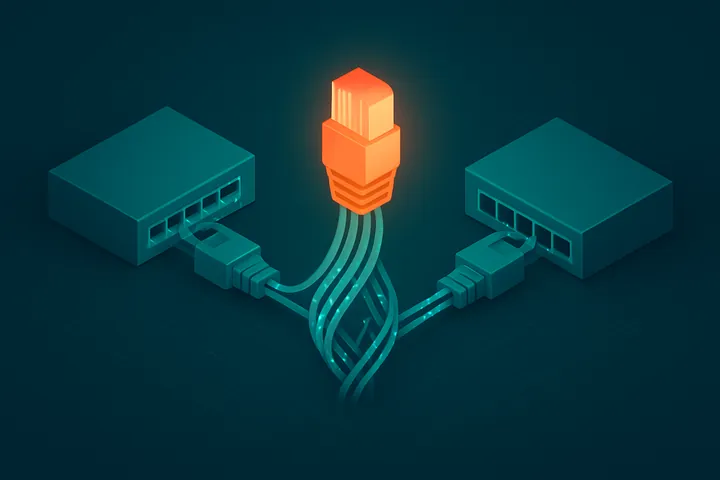
Port Channel Definition: A logical link bundling multiple physical Ethernet ports into one, increasing bandwidth and redundancy. Standardized as 802.3ad/LACP link aggregation.
A port channel is a logical interface that bundles two or more physical Ethernet links between devices into a single high-bandwidth, fault-tolerant connection. Also known as link aggregation, an EtherChannel (Cisco), or a LAG, it increases throughput beyond a single link and provides redundancy so traffic continues if one member link fails.
Member links are aggregated and traffic is distributed across them using a load-balancing hash, typically based on source/destination MAC, IP, or TCP/UDP port values, so individual flows stay on one link to preserve packet order. Channels can be configured statically or negotiated dynamically using the Link Aggregation Control Protocol (LACP, IEEE 802.3ad/802.1AX) or Cisco's PAgP. To Spanning Tree Protocol, the bundle appears as one logical link, avoiding loops while using all members. Multi-Chassis LAG (MLAG/vPC) extends a port channel across two switches for device-level redundancy.
For security and resilience, port channels eliminate single points of failure in critical paths such as switch uplinks, server connections, and firewall interfaces, supporting availability, a core element of the CIA triad. They also enable graceful capacity scaling and seamless maintenance. Misconfiguration carries risk: mismatched parameters between ends can cause a link to be suspended, and forming channels with untrusted devices could be leveraged in an attack, so consistent configuration and protocol authentication matter.
For example, a data-center switch connects to a server's two 10 Gbps NICs. Bundling them into an LACP port channel gives the server a 20 Gbps logical link with automatic failover: if one cable, transceiver, or NIC fails, LACP detects the loss and instantly shifts all flows to the surviving member with no manual intervention and minimal disruption, keeping a business-critical application reachable while a technician replaces the failed component.
Port Channel is one of the topics you'll master in the Cisco CCNA Boot Camp.
Cisco CCNA Boot Camp →